

Dark Circles

Dermal Fillers for Dark Circles in Baner, Pune - Tear Trough and Under Eye Treatment at Skinsure Clinic
You sleep well, drink water, use your eye cream every night – and the dark circles are still there every morning. Not fading. Not responding to any topical product. Completely unaffected by how rested you actually are.
This type of dark circle is not a skin problem. It is a volume problem. The hollow between the lower eyelid and the upper cheek creates a shadow. That shadow looks dark regardless of how much sleep you have had. No eye cream can fix a shadow caused by anatomy. Dermal filler can.
At Skinsure Clinic in Baner, Pune, Dr. Rashmi Soni Lohiya first establishes which type of dark circle is present before recommending any treatment. This matters more for the under-eye area than anywhere else on the face – because filler only works for one specific type of dark circle, and using it for the wrong type gives no result at all.
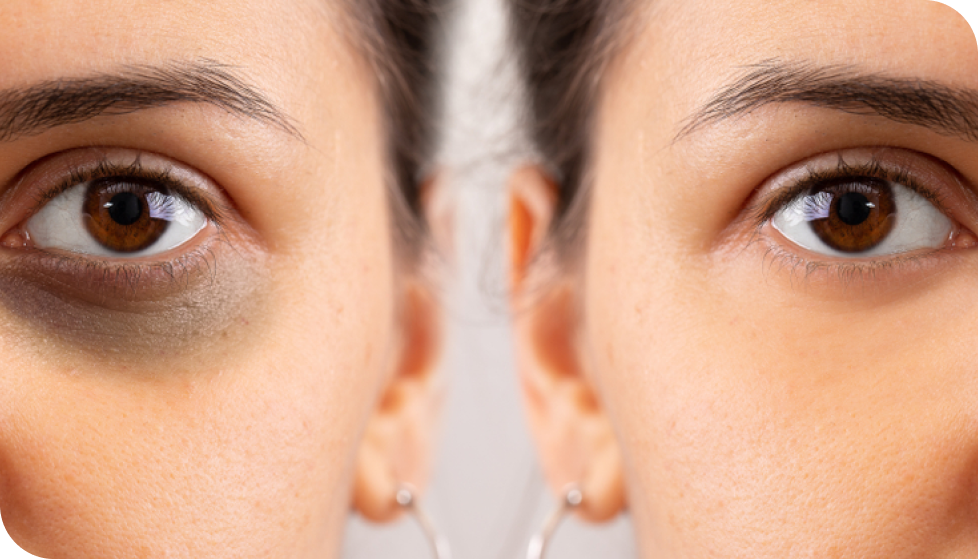
The 4 Types of Dark Circles - Which One Do You Have?
This is the most important thing to understand about dark circles – and it is the reason most people spend years on eye creams that do nothing. Dark circles are not one condition. They are four completely different conditions that happen to look similar and share a name.
Type 1 - Volume Shadow (Structural Dark Circles)
Cause: Loss of volume in the tear trough – the hollow between the lower eyelid and the upper cheek – creates a shadow that looks dark.
How to identify it: The darkness is most visible in overhead lighting. It looks worst in photos taken from slightly above. The area feels soft and hollow when pressed gently. Sleep and hydration make no difference.
Treatment: Tear trough filler. This is the only type that responds to filler. Results are often dramatic – the darkness disappears with the hollow that was causing the shadow.
Type 2 - Pigmentation Dark Circles
Cause: Excess melanin in the under-eye skin creates genuine colour – brown, grey or bluish discolouration of the skin itself.
How to identify it: The darkness has a distinct skin colour – if you stretch the skin under the eye and the dark colour moves with the skin, it is pigmentation. Common in Indian and darker skin tones. Does NOT improve with filler.
Treatment: Prescription brightening topicals, Q-Switch laser, chemical peels. Filler will not help – the colour is in the skin layer, not caused by a hollow below it.
Type 3 - Vascular (Blue or Purple Dark Circles)
Cause: Blood vessels visible through the thin under-eye skin create a bluish or purplish discolouration.
How to identify it: The darkness has a clearly blue or purple tone. Worsens when cold, tired or after alcohol. The skin in this area is very thin – you can sometimes see the vessels themselves. Common in patients with fair skin in Baner and Pune.
Treatment: Filler can partially help by adding volume that reduces vessel visibility. Skin boosters improve skin thickness. Laser treatments target the visible vessels. Often a combination approach works best.
Type 4 - Fat Herniation (Puffy Bags with Shadows)
Cause: The fat pad behind the lower eyelid protrudes (herniates) forward, creating a bulge. The shadow below the bulge looks dark.
How to identify it: The under-eye looks puffy in the morning and sometimes throughout the day. There is a clear convex bulge followed by a shadow below it. This is not a hollow – pressing gently reveals something firm and slightly raised.
Treatment: Filler in the hollow below the bulge can reduce the shadow by smoothing the transition. But filler does not remove the herniated fat – that requires a surgical procedure (blepharoplasty). Filler is a partial improvement only for this type.
What Is the Tear Trough and Why Does It Create Dark Circles?
The tear trough is the name for the hollow that forms between the lower eyelid and the upper cheek. Understanding why it forms helps explain exactly what filler does to correct it.
The anatomy beneath the under-eye:
- Directly beneath the thin under-eye skin sits the orbicularis oculi muscle - the ring-shaped muscle that controls eyelid movement
- Below the orbicularis is a ligament called the tear trough ligament, which tethers the skin to the bone of the orbital rim
- Below this ligament is the malar fat pad - the fat that fills out the upper cheek
- The orbital fat pad sits behind the eye and may herniate forward in some patients (Type 4)
Why the tear trough hollow develops:
- With age, the malar fat pad below the tear trough ligament reduces in volume and descends
- As the fat descends, the tear trough ligament becomes the visible demarcation line - the boundary between the eyelid above (where fat remains) and the hollow below (where fat has gone)
- The resulting hollow casts a shadow - which is the "dark circle" that does not respond to sleep or eye cream
- In younger patients, the tear trough hollow can be constitutional (genetic) - they have always had a deeper orbital rim and less sub-orbital fat, creating a hollow from early adulthood
What filler does:
- Filler placed in the tear trough area fills the hollow between the orbital rim and the upper cheek
- By filling the space that was casting the shadow, the shadow disappears
- The transition from eyelid to cheek becomes smooth - the face looks rested even without any colour change in the skin
Why Tear Trough Filler Is the Most Technically Demanding Filler Area
Tear trough filler is the most commonly requested and the most technically demanding filler treatment available. More complications from dermal filler globally originate from the tear trough area than from any other injection site. Patients considering this treatment deserve to understand why.
What makes the tear trough uniquely challenging:
Extremely thin skin. The under-eye skin is the thinnest on the face – 0.5mm in some areas. Filler placed too superficially in this area is visible through the skin, creating lumps, the Tyndall effect (a bluish discolouration from light scatter through filler), or visible ridges. Correct depth placement is critical.
The Tyndall effect. This is the most common complication of tear trough filler. When HA filler is placed too superficially under the thin under-eye skin, the optics of light scattering through the filler creates a bluish discolouration – sometimes making the area look darker than before treatment. Prevention requires deep placement (at or below the orbicularis muscle) using a thin, hydrophilic HA product.
Dense vascular network. The periorbital area has a complex, dense network of arteries and veins. Vascular occlusion – where filler inadvertently enters a blood vessel – is the most serious complication of any filler treatment. While rare, this risk is higher in the tear trough area than in most other injection zones. Cannula technique and slow, careful injection significantly reduce this risk.
Wrong product causes visible lumps. The tear trough requires the softest, most hydrophilic HA filler available. Products designed for cheeks or jawline are too stiff for this area – they cause visible ridges and palpable lumps under the thin skin. Product selection for tear trough is different from every other filler area.
Stay in the touch.
Unlock the secrets to radiant skin by staying in touch with Skinsure Clinic. Join our community for expert skincare tips, exclusive offers, and the latest updates on revolutionary treatments
Who Is a Good Candidate for Tear Trough Filler in Baner, Pune?
Good candidates - filler will help significantly:
- Type 1 structural dark circles - a hollow tear trough creating a shadow in the under-eye
- Patients who look tired regardless of sleep because of hollow under-eyes
- Patients with constitutional tear trough hollowing from early adulthood (genetic)
- Patients who have lost under-eye volume with age - typically from the mid-30s onwards
- Patients who have had cheek volume loss and have a noticeable step from eyelid to cheek
Poor candidates - filler will give limited or no result:
- Type 2 pigmentation dark circles - skin colour is the issue, not a hollow. Filler will not change skin colour
- Type 4 fat herniation (puffy bags) - filler can soften the shadow below the bag but cannot remove the herniated fat itself
- Very thin, papery under-eye skin where any filler will be visible regardless of depth - better served by skin boosters first to improve skin quality
- Patients with significant under-eye puffiness - adding filler to an already puffy area can make the puffiness more noticeable
Combination approach for mixed presentations:
- Type 1 + Type 2 combined (hollow plus pigmentation): tear trough filler for the hollow + prescription brightening topicals for the pigmentation component
- Type 1 + Type 4 combined (hollow below a fat bag): cheek filler to lift the upper cheek + small amount of tear trough filler in the true hollow - not into the area of the fat bag
- Any type with thin, dry under-eye skin: skin boosters first to improve skin quality, tear trough filler at a separate session after the skin is thicker
What to Expect - Tear Trough Filler Session at Skinsure Clinic, Baner, Pune
Before the session:
- Full under-eye assessment - Dr. Rashmi confirms the type of dark circle and whether filler is appropriate
- Mirror test performed to confirm the hollow and shadow relationship
- Numbing cream applied to the under-eye area 20 to 30 minutes before
- Honest discussion of expected outcome and volume - a conservative approach is always taken first
During the session:
- Duration: 20 to 30 minutes
- Fine cannula used for most patients - single entry point per side, minimal trauma to the delicate tissue
- Filler placed at sub-muscular depth - not in the superficial skin layer
- Small, precise deposits placed along the orbital rim to fill the hollow evenly
- Assessed in the mirror mid-session - product adjusted before completion
After the session:
- Mild puffiness under the eye is normal for 24 to 72 hours - this is temporary swelling, not the final result
- Possible mild bruising for 3 to 5 days - the under-eye bruises more visibly than most filler areas
- Cold compress applied at the clinic and for the first 24 hours at home
- Avoid blood-thinning medications where possible for 1 week before and after
- Do not rub or press the under-eye area for 48 hours
Results and duration:
- Swelling resolves at day 5 to 7 - result visible from this point
- Full settled result at day 10 to 14
- Duration: 12 to 18 months for tear trough filler - longer than lips because the orbital area has very low muscle movement
- Top-up at 12 months maintains the result continuously
results
Frequently Asked Questions - Dark Circles Filler in Baner, Pune
Filler removes dark circles caused by a structural hollow - which is Type 1 structural dark circles. When a hollow (called the tear trough) forms between the lower eyelid and the upper cheek, it casts a shadow that looks dark regardless of skin colour, sleep or hydration. Filling this hollow with tear trough filler eliminates the shadow. The result can look dramatic - patients who have been told they look tired for years often look noticeably more rested immediately after the swelling from the procedure settles at day 5 to 7. However, filler does not work for pigmentation-type dark circles (brown or grey skin colour in the under-eye area), which require skin brightening treatment instead.
A simple self-test: look up at the ceiling in natural daylight while watching your under-eye area in the mirror. If the dark shadow reduces when you look up (because the hollow shifts with eyelid position), the darkness is structural and tear trough filler will help significantly. If the dark colour stays the same regardless of eyelid position, it is pigmentation or vascular in origin, and filler is not the right treatment. At Skinsure Clinic in Baner, Dr. Rashmi performs a full under-eye assessment at the consultation - including the mirror test and palpation - to confirm the type of dark circle before recommending any treatment.
Tear trough filler is safe when performed by an experienced dermatologist using the correct product and technique. The main risks specific to this area are: the Tyndall effect (a bluish discolouration if filler is placed too superficially - prevented by deep sub-muscular placement), lumps from using an inappropriate stiff filler product (prevented by using soft, high-hydrophilicity HA), bruising (common and temporary - resolves in 3 to 5 days) and, very rarely, vascular occlusion. At Skinsure Clinic in Baner, Dr. Rashmi uses only soft, thin HA filler placed with a fine cannula at sub-muscular depth, and hyaluronidase is available for immediate reversal if needed.
Tear trough filler typically lasts 12 to 18 months - longer than most other filler areas because the under-eye has very low muscle movement compared to the lips or smile lines. The result fades gradually. A top-up session at 12 months before the filler fully dissolves maintains the improvement continuously. Some patients find their tear trough area retains its shape for longer after multiple sessions - the repeated HA presence over time may stimulate some additional periorbital tissue quality improvement.
Skinsure Clinic offers tear trough and dark circle filler treatment in Baner, Pune, led by Dr. Rashmi Soni Lohiya - a dermatologist with 23 years of experience and specialist cosmetology training from KEM Hospital, Pune. The clinic is at the 7th floor of Lunawat Apex, Baner Road, behind the Nexa showroom, near Sadhu Vaswani Nagar, Aundh, Pune 411007. Easily accessible from Baner, Aundh, Balewadi, Wakad, Hinjewadi and PCMC. Call 099606 03380 to book a consultation.